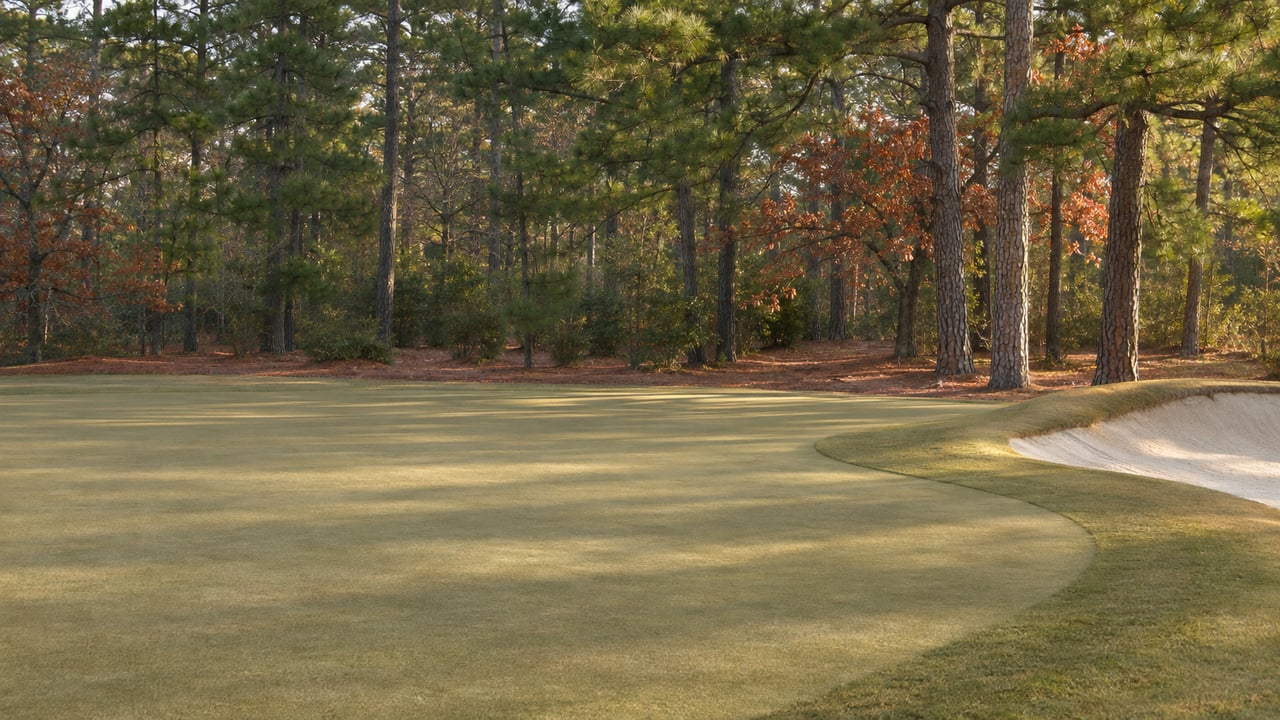
Forest Creek's South Course came back at the start of October after a seven-month restoration led by Tom Fazio, the architect who opened it in 1996. The greens members are putting on now were sprigged with TifEagle Bermuda over the summer. They have had one growing season. The coming months are their first Sandhills winter.
The South will look different in December than it did in October, and the age of its greens is the reason. Turf scientists treat a young ultradwarf green as a different case from an established one, and they protect it from cold much sooner. If you play the South this winter and find blankets on the greens, a tan putting surface or a later first tee time, all three come with having new greens.
What seven months bought
Club + Resort Business reported that work started in March and ran through September, with a crew of about 30 to 40 people working six days a week. The crew rebuilt every green and bunker, made major irrigation improvements, improved the tees and removed selected trees to let in more sunlight and air. They also replaced the original bentgrass greens with ultradwarf Bermuda.
Three figures from the same report give the size of the job:
- About 14 miles of drainage pipe now runs under a single 18-hole course. The same report called drainage one of the project's biggest infrastructure investments.
- More than 700,000 square feet of sod went down, which works out to roughly 16 acres of new turf.
- About 4,200 bushels of bermudagrass sprigs were planted, and those sprigs are what the new greens grew from.
LaBar Golf led construction. Director of Agronomy Connor Moser and Director of Golf and Athletics T.J. Boulanger led the club's own agronomy and golf teams, and Dave Delsandro, co-founder of Agronomic Advisors, consulted. Owner Robert McCann told the magazine that the aim was "to respect what makes the South Course special while giving it the foundation it needs for the next 30 years."
You will also see the work from the tee box. The club's South Course page says the enhanced tees "add new ways to play several holes." It also quotes Fazio on why he came back: "The design has stood the test of time, but it was time to go back to the guts, rebuild some parts and refresh other parts."
I covered the project in an earlier post written while the South was still closed. The difference now is that the work is finished and the new turf has to get through its first cold season.
All 36 holes now putt on Bermuda
The South was the second of Forest Creek's two courses to make the switch. In an interview with LINKS Magazine, Fazio described converting the North Course's bentgrass greens to Champion Bermuda for better year-round conditions. "More people are using the club as their primary residence, so there is more summer play," he said. "The Champion Bermuda holds up much better than bentgrass in the higher temperatures."
The club gave the same reason for the South. Its restoration announcement said Pinehurst's climate had become warmer and more humid, and bentgrass was "no longer the most reliable choice for peak performance." The club also had a test case close to home. The Hog Hole, the par 3 over water that sits along the drive from the South's 18th green to the Clubhouse, had "flourished since converting to Bermuda."
So this winter, every green at Forest Creek is an ultradwarf Bermuda green. The two courses use different cultivars, Champion on the North and TifEagle on the South, and their greens are very different ages. That difference in age matters more than anything else once the cold arrives.
Why young greens get covered sooner
The USGA Green Section says the ultradwarf varieties Champion, MiniVerde and TifEagle thrive in summer heat. It also names cold as their "major weakness." The same 2023 article lists 2014, 2018 and 2021 as winters that brought turf loss to many courses across the Southeast and Central regions.
Its covering guidance sets different thresholds for different greens:
| Green | When USGA guidance calls for covers |
|---|---|
| Established ultradwarf green | Forecast air temperatures below 20°F, using one black woven cover |
| Established green on a very cold night | Below 15°F, using two covers |
| Young green, or one in heavy shade or an exposed spot | Forecast lows below 30°F |
A green sprigged in summer 2026 counts as young. Under USGA guidance, then, a young green gets covered on a forecast that is ten degrees warmer than the trigger for an established green. A cold Sandhills night in the upper 20s would not call for covers on an established green under that guidance, but it falls inside the range for a green in its first winter.
The same guidance pushes in the other direction early in the season. The 2023 USGA article asks superintendents to let greens harden off naturally in the fall and warns that "frequent unnecessary covering" can interrupt that process. Covering the greens is a decision made forecast by forecast, and every set of covers that goes on has to come off before anyone can putt.
Forest Creek has dealt with this before. In January 2014, a polar vortex dropped overnight lows in Moore County into the single digits, and the club's maintenance blog described the rule of thumb it used at the time: cover when lows of 25°F or lower were forecast for two or more nights in a row and daily highs stayed under 50°F. The post also said shaded and north-facing greens are more vulnerable and are sometimes covered when others are not. That rule describes how the club worked more than a decade ago, so it is history and not this season's policy. It does show that covering Bermuda greens is not new at Forest Creek.
The practice also has a long local history. The same post traces winter covering in the South back to the 1920s, when greenkeepers covered their summer Bermuda greens with pine straw and putted on temporary winter greens set out in front. In the Sandhills, pine straw was the first winter cover.
What a Bermuda winter looks like from the first tee
USGA's Southeast regional update from December 2024 opened with an early December snowfall in Pinehurst, which it called a reminder to have plans ready to protect ultradwarf greens. These are the changes golfers are most likely to see on the South and North this winter:
- Covers on the greens. On cold nights, black woven fabric goes over the putting surfaces, and crews take it off before play the next day. The new South greens meet the "young green" definition, so covers may go on there on nights when established greens would stay uncovered.
- A higher, slower surface. USGA recommends raising the mowing height by about 25% as the turf heads into winter. It also recommends alternating mowing and rolling so the greens stay playable without damaging slow-growing or dormant turf.
- Tan or painted greens. Bermuda loses color as it goes dormant. USGA advises applying pigments before much of that color is gone, because applying them after the first frost loses the benefit of warming the turf and extending its growing season.
- Frost delays. The USGA describes a frost delay as a way to prevent lasting damage to the course.
Most of the remaining winter work happens out of sight. NC State's turf pathology program notes that dormant or semi-dormant bermudagrass greens still need attention for disease. It also reports that wetting agents combined with proper winter covers improve how the turf looks over the winter and how it greens up in spring.
For the South Course, that spring green-up comes next year, when TifEagle greens sprigged in summer 2026 come out of their first dormancy.
If you're a Forest Creek member, or you're thinking about life at Forest Creek and want to know how the two courses play from season to season, I'm always happy to talk golf. I follow these projects closely because they change daily life inside the gates. Reach out to Kelly Ward KW Realty and let's connect.